Japan Cherry Blossom Forecast 2027: Tokyo, Osaka and Kyoto Bloom Dates and Trip Planning Guide
- Cherry blossoms in Tokyo, Osaka and Kyoto usually open in late March, on average between March 24 and 27, and reach full bloom about 7 to 9 days later, so early April is the peak
- The date shifts by a few days to two weeks each year: in the last six years Tokyo's first bloom came as early as March 14 and as late as March 29
- The first 2027 cherry blossom forecasts usually come out in January
If you are planning a spring trip to Japan this autumn, the big question is when the cherry blossoms will open. The first 2027 forecasts usually arrive in January, and until then, guessing a single date is an easy way to book the wrong flights.
A more useful approach is to look at 30 years of JMA normals and the last six years of real observations, so you know the usual window and how much it moves, then fine-tune once the January forecasts arrive.
When the 2027 cherry blossom forecasts come out: usually January
Three private weather companies publish the main forecasts: Japan Weather Association, Weathernews and Japan Meteorological Corporation. Their past first-forecast dates give a good idea of when to start checking for 2027, and we'll update this guide once the forecasts are out.
| Forecaster | Past first forecast |
|---|---|
| Japan Weather Association (tenki.jp) | 2026 season: Jan 29, 2026 |
| Weathernews | 2025 season: Jan 9, 2025; 2026 season: Jan 8, 2026 |
| Japan Meteorological Corporation | 2020–2025 seasons: Jan 9–14 each year; 2026 season: Dec 18, 2025 |
Weathernews has released its first forecast in January in past years, yet its sakura page says next season's information is planned for February 2027. The two do not match, but in past years Weathernews released its first forecast around January 8–9. Even if it slips to February, the Japan Weather Association (January 29 for the 2026 season) and Japan Meteorological Corporation (December to mid-January in past seasons) come out earlier, so going by past years you will see at least one forecast in January.
Japan Meteorological Corporation published almost a month earlier than usual for the 2026 season and says it started using AI-based long-range forecasting that season. If you want the earliest look, keep an eye on its news page from December.
Forecasts keep updating
Japan Weather Association's January 29, 2026 release said the next forecast would appear on tenki.jp on February 26, with weekly Wednesday updates including full-bloom forecasts from March. Japan Meteorological Corporation issued 14 rounds for the 2026 season, the last on April 23. Checking the latest round a week before you fly is more reliable than the first one in January.
JMA normals: Tokyo blooms March 24, Osaka March 27, Kyoto March 26
"First bloom" and "full bloom" have official definitions. According to the JMA, first bloom is the first day five or six or more flowers are open on the sample tree, and full bloom is the first day about 80% or more of the buds are open. The main variety observed is Somei-yoshino. Normals are averages for 1991–2020:
- Tokyo: first bloom March 24, full bloom March 31
- Kyoto: first bloom March 26, full bloom April 4
- Osaka: first bloom March 27, full bloom April 4
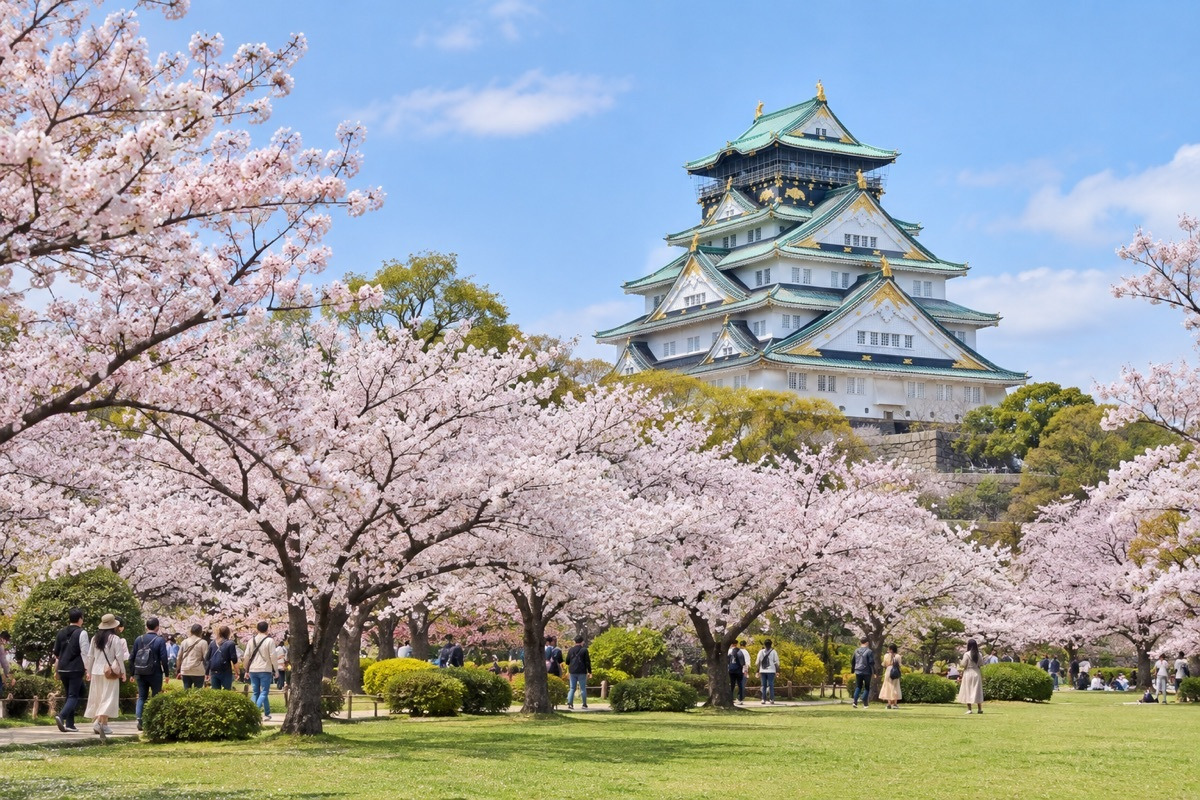
Osaka's sample tree is in Osaka Castle Park
Osaka's sample tree stands in the Nishinomaru Garden in Osaka Castle Park. It is the Somei-yoshino chosen by the Osaka Regional Headquarters of the JMA, and Osaka's first bloom is announced when five or six flowers open on it. If you would like to see it, our Osaka cherry blossoms 2027 guide covers the garden.
Actual bloom dates 2021–2026: Tokyo moved by 15 days
Normals are averages, and real dates shift each year. Here are the JMA's observed dates for the last six years.
| Year | Tokyo first / full | Kyoto first / full | Osaka first / full |
|---|---|---|---|
| 2021 | 3/14 / 3/22 | 3/16 / 3/26 | 3/19 / 3/28 |
| 2022 | 3/20 / 3/27 | 3/24 / 3/30 | 3/23 / 3/30 |
| 2023 | 3/14 / 3/22 | 3/17 / 3/24 | 3/19 / 3/27 |
| 2024 | 3/29 / 4/4 | 3/29 / 4/5 | 3/30 / 4/6 |
| 2025 | 3/24 / 3/30 | 3/27 / 4/5 | 3/27 / 4/4 |
| 2026 | 3/19 / 3/28 | 3/23 / 3/30 | 3/26 / 4/3 |
| Normal | 3/24 / 3/31 | 3/26 / 4/4 | 3/27 / 4/4 |
- Over these six years, Tokyo's first bloom ranged from March 14 to March 29, a spread of 15 days.
- Osaka ranged from March 19 to March 30 (11 days).
- Kyoto ranged from March 16 to March 29 (13 days).
- From first bloom to full bloom took 6 to 9 days in Tokyo, 7 to 9 in Osaka and 6 to 10 in Kyoto.
These are past records. For 2027, follow the forecasts from January, then the JMA's actual observations in March.
Planning your cherry blossom trip ahead of the January forecasts
If you need to book now, use the normals and the six-year range to set a wider window: Tokyo has fallen between mid-March and early April, with Osaka and Kyoto a few days later.
For a single-city trip, centring your dates on the normal full-bloom day gives you a chance either way if the season runs early or late. If seeing peak bloom is the whole point, book flights you can change, then shift your dates a few days earlier or later once the first forecast comes out in January.
Some spots do not follow Somei-yoshino
The weeping cherry at Rikugien in Tokyo opened on March 14, 2026 and reached its best on March 21, earlier than Tokyo's official first bloom of March 19. Osaka Mint's cherry blossom passage, mostly double-flowered varieties, has opened in early to mid-April in recent years. Our Tokyo cherry blossoms 2027 and Osaka cherry blossoms 2027 guides show how to pick places by travel date.
Getting around in cherry blossom season when dates are uncertain
The tricky part of cherry blossom season is that you book before you know which day will peak, so plans often change on the ground: the park you saved for day three may need to move to day one. City spots are easy by train, but stringing two or three spots together in a day with older parents or kids means a lot of transfers and walking.
This is where a private car helps. If the bloom shifts, you can change the order of stops on the day and head first to wherever looks best. You can link two or three spots in one day and ride straight between them instead of hunting for stations and transfers, and older parents or kids can rest in the car between stops.
Chidorigafuchi in Tokyo has no parking and runs one-way foot traffic on weekends during the illuminations. The Osaka Mint passage has no parking and no drop-off area for tour buses. These are public transport only and not suitable for a car.
A private car makes more sense for longer, transfer-heavy days, such as central Tokyo to Showa Kinen Park, or Osaka to Nijo Castle in Kyoto.
Entry fees at major cherry blossom spots
When planning, it helps to know the entry fees. These are the official prices from our other two guides.
| Spot | Adult | 65+ | Children |
|---|---|---|---|
| Shinjuku Gyoen (Tokyo) | 500 | 250 | Free up to junior high |
| Rikugien (Tokyo) | 300 | 150 | Free up to elementary |
| Showa Kinen Park (outer Tokyo) | 450 | 210 | Free up to junior high |
| Ueno Park, Chidorigafuchi path, Meguro River | Free | Free | Free |
| Osaka Castle Nishinomaru Garden | 300 (regular) | 300 (free for Osaka City residents, ID required) | Free up to junior high |
| Nijo Castle (Kyoto, entry + Ninomaru Palace) | 1,300 | — | Junior/senior high 400, elementary 300 |
Prices in the table are in JPY. Nishinomaru Garden's 300 yen is the regular fee; its cherry season hours and fees differ, and our Osaka cherry blossoms 2027 guide covers them. Night illuminations usually cost extra; see each guide.
Where to stay for cherry blossoms: pick an area that reaches everywhere
If you book your hotel early, choose an area with easy access to everywhere, so you can switch spots the next day without changing hotels. For Tokyo, our Tokyo accommodation areas 2026 guide compares Shinjuku, Ueno and Tokyo Station by airport access and stations. If you will split time between Osaka and Kyoto, see Osaka accommodation areas 2026 and Osaka to Kyoto transport 2026.
Japan cherry blossom forecast 2027 FAQ
When will Tokyo's cherry blossoms open in 2027?+
The first 2027 forecasts usually come out in January, and we'll update this guide then. Until then, the JMA normal for Tokyo is first bloom on March 24 and full bloom on March 31.
When will the 2027 forecasts be released?+
Usually in January. For the 2026 season, Weathernews published on January 8 and Japan Weather Association on January 29. Japan Meteorological Corporation went earlier, on December 18 of the previous year.
What is the difference between first bloom and full bloom?+
By the JMA definition, first bloom is the first day with five or six or more flowers open on the sample tree, and full bloom is the first day about 80% of buds are open. In the last six years Tokyo went from first to full bloom in 6 to 9 days.
Some sites already list 2027 bloom dates. Are they reliable?+
If they were not published by one of the three forecasters or the JMA, they are not official forecasts. Once the 2027 forecasts are out, we'll add the dates to this guide.
Which blooms first, Osaka or Kyoto?+
The normals are Kyoto March 26 and Osaka March 27, just one day apart, and either city has come first in recent years. Both have a full-bloom normal of April 4.
Can cherry blossom events book out?+
Some need reservations. The Osaka Mint passage used advance reservations every year from 2022 to 2026, and Shinjuku Gyoen says it may require reservations on cherry season weekends. These schedules are usually announced between January and March, so plan the Mint as if it needs a reservation: keep it in an early-to-mid-April slot and book once dates are out.
